
In many teams, quality assurance is still treated as a final gate: we'll build everything, then we'll give it to QA to test at the end. Modern practice – and a lot of painful experience across the industry – shows this is one of the most expensive ways to build software. The later you discover a defect, the more code, logic, and dependencies it has already touched, and the more painful and costly it is to fix.
At Pragmica, we look at QA as an ongoing process embedded into every stage of the development cycle, not as a single step at the finish line. Let's break down why that matters and what it changes in practice.

What we mean by QA (and what we don't)
Quality assurance is not just clicking around the UI or finding bugs at the end. In a healthy process, QA is responsible for clarifying requirements and edge cases early, helping ensure that features are testable and measurable, designing test strategies and scenarios (not only individual test cases), preventing defects (not only detecting them), and balancing manual exploratory testing with automation where it brings leverage.
In other words, QA is about building a reliable system for quality, not heroically catching problems at the last possible moment.
Why "testing at the end" is so expensive
Multiple studies and industry reports show the same curve: the cost of fixing a bug grows dramatically the later you find it. Bugs found during design are relatively cheap to correct. The same issue, if discovered during acceptance or after release, can cost ten to thirty times more due to rework, hotfixes, and user impact.
Late discovery means you often need to revisit requirements, refactor core modules, rewrite tests, re-align stakeholders, and delay releases or ship with known risks. Embedding QA early – so-called shift-left testing – is essentially an insurance policy: you pay a predictable cost upfront to avoid chaotic costs later.

What changes when QA is in the whole SDLC
When QA is involved from the requirements and discovery phase, they ask uncomfortable but crucial questions: what happens in this edge case, what if the API is slow or unavailable, how will we know this feature is done and working as intended? This turns vague wishes into testable requirements, reducing ambiguity and hidden assumptions.
With QA engaged during design and implementation, issues are discovered in smaller, more localized contexts. Unit tests and integration tests catch logic issues, early exploratory testing catches UX and flow problems, and static and early testing catches inconsistencies before they even reach production code. Instead of a giant bug wave at the end of a sprint or release, you get a steady stream of manageable findings.
It sounds counterintuitive, but involving QA early actually accelerates time to market. Fewer last-minute blockers stop releases, regression risk is lower, and automated checks make CI/CD pipelines safer and more predictable. You ship more often with less stress, instead of living in crunch mode every time.
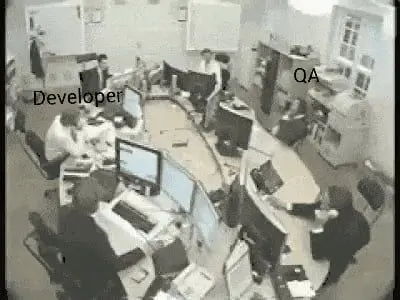
When QA is embedded instead of siloed, developers, designers, and QA talk about quality together, quality becomes a shared responsibility (not QA's problem), and product owners get earlier visibility into risks and trade-offs. That shift in culture is often more valuable than any individual bug fix.
At the end of the day, QA is there so that users experience fewer crashes and weird edge cases, behavior is consistent across browsers, devices, and usage patterns, and the product feels reliable, not randomly broken sometimes. That reliability is a core ingredient of brand trust, especially in fintech, health, B2B tools, and infrastructure products.
Where QA belongs in each stage of the cycle
Here's how we like to integrate QA in a typical product lifecycle at Pragmica:
- Discovery & requirements
QA helps validate assumptions, clarify acceptance criteria, and highlight risky areas early. - UX / UI design
QA reviews flows for edge cases and consistency, and checks if the design is testable and technically realistic. - Architecture & planning
Together with engineers, QA helps identify critical paths, integration points, and areas requiring deeper coverage. - Development
- Developers run unit and integration tests.
- QA designs higher-level scenarios, creates test data, and prepares automation where it makes sense.
- System & regression testing
QA leads structured testing (manual + automated), exploratory sessions, and regression suites before releases. - Release & monitoring
QA helps define what "healthy" looks like in production: error budgets, key metrics, and post-release checks. - Maintenance & evolution
As new features ship and old ones are refactored, QA keeps the quality baseline from silently eroding.
This approach maps well to Agile, but also improves more traditional processes by pushing quality concerns earlier instead of parking them at the end.

What this means for clients and teams
For clients, early and continuous QA means more predictable timelines and fewer we discovered a critical blocker last night moments, clearer risk visibility before important releases, and lower long-term cost of ownership because you're not constantly paying for hidden legacy issues.
For teams, it means less firefighting, better understanding of requirements, and more time spent building value instead of debugging chaos.
At Pragmica, we try to avoid the illusion that quality can be added at the end. For us, QA is baked into the way we scope, design, and ship software – from the first workshop to the post-release retrospectives. QA is not a phase – it's a continuous practice. Involving QA from day one significantly reduces risk, cost, and stress. Early QA means clearer requirements, better collaboration, and faster releases. Treat QA as part of your product's design and architecture, not as a checkbox before launch.